
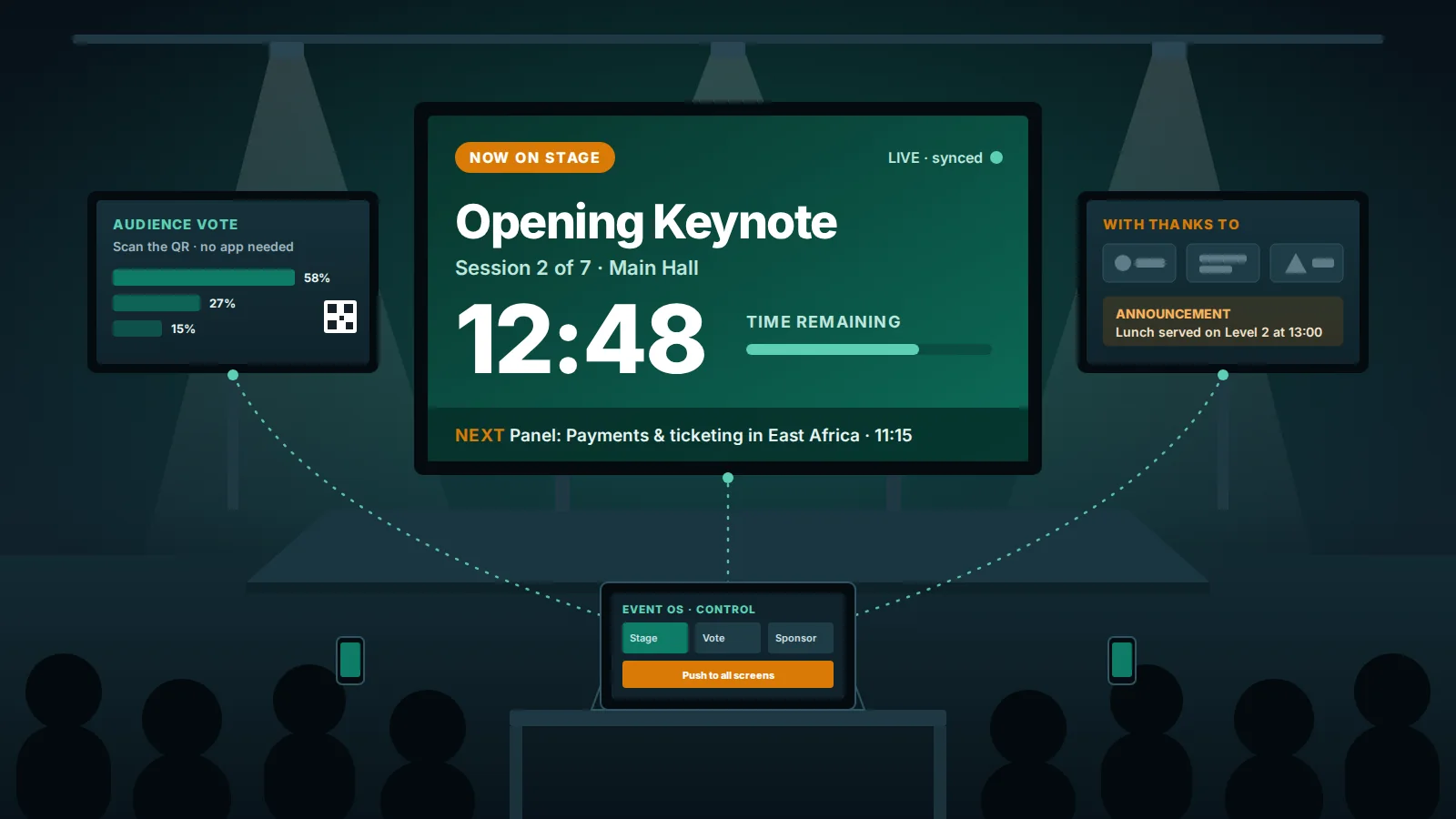
East Africa's events industry is moving beyond printed programmes, manual guest lists and ordinary television screens.
Across Tanzania, Kenya, Uganda and Rwanda, organizers are increasingly using technology to manage registration, control venue access, communicate with guests and display live information during events.
The important change is not simply that more screens are being installed. Buyers now expect those screens to receive accurate information from one central system and update immediately when something changes.
For event organizers, MCs, hotels, conference venues, casinos and corporate marketing teams, this creates both an opportunity and a warning: a screen without an effective control system is still just a television.
Digital ticketing is becoming standard
According to a Live Nation Entertainment announcement published on 20 August 2026, Ticketmaster-backed Quicket is now live in Kenya and Uganda, with local payment options including M-Pesa, MTN Mobile Money and Airtel Money. AllAfrica also reported the Kenya launch.
This is an important signal. Large international technology companies now recognize that East Africa has a commercially valuable live-events market.
However, succeeding in this region requires more than accepting bank cards. Systems must accommodate mobile-money payments, smartphones, inconsistent internet connections and event teams with different levels of technical experience.
Local providers are moving in the same direction. Kenyan ticketing platforms such as Karibisha and JAVI Tickets advertise QR-code scanning at the gate, check-in from a smartphone and real-time attendee tracking.
This means organizers will increasingly expect a complete digital process:
- A guest registers or buys a ticket.
- The guest receives a unique QR code.
- Event staff scan the code at the entrance.
- The system records the guest's arrival.
- Live attendance information becomes available to the organizer.
- Relevant information is displayed inside the venue.
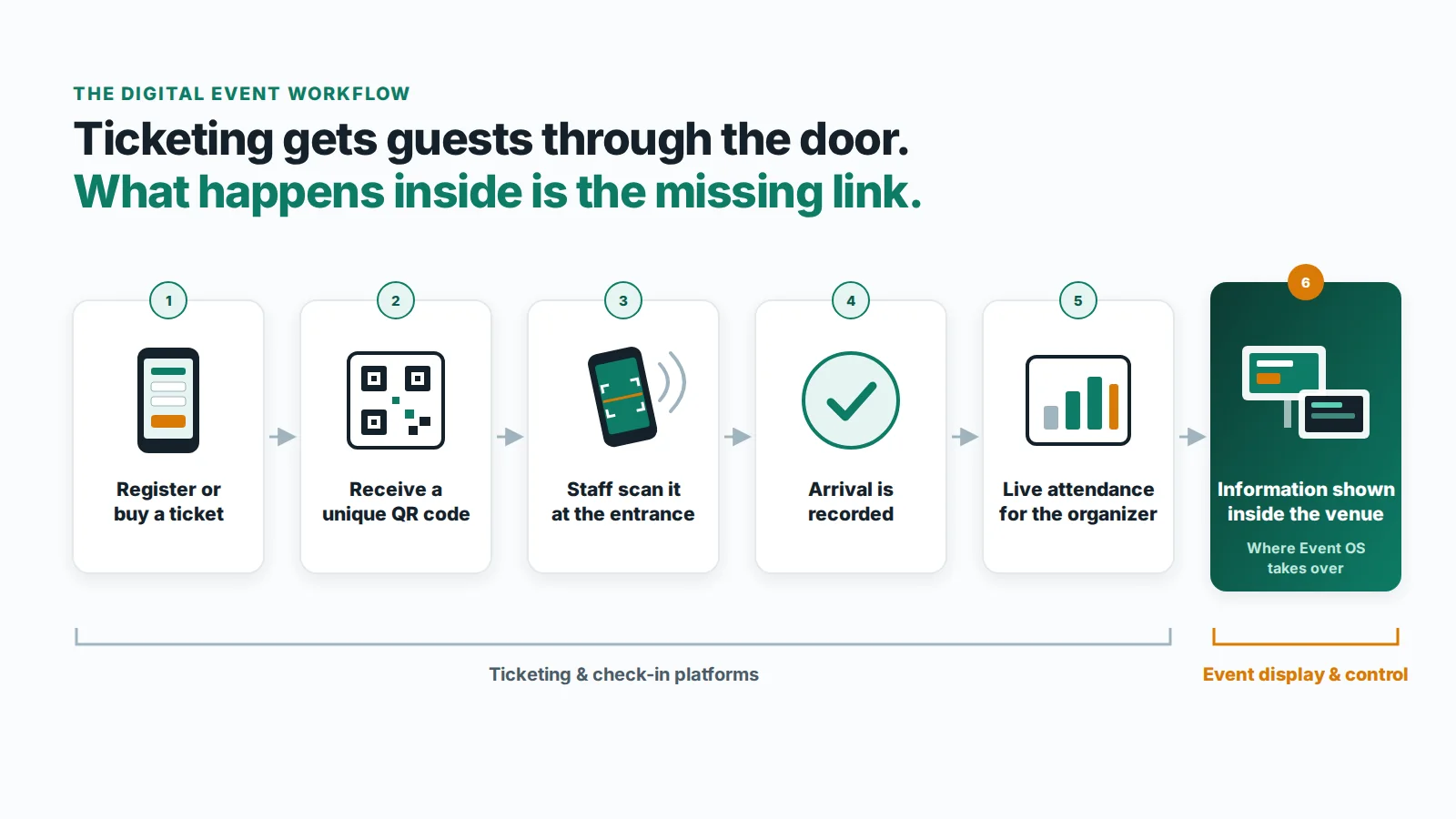
Ticketing is therefore only the beginning of the event workflow.
The missing link is what happens inside the venue
Most ticketing systems concentrate on selling tickets and confirming entry. Once guests enter the venue, organizers still need to manage many activities manually.
The MC needs the latest programme. The AV operator needs to know what should appear on the screen. Sponsors expect visibility. Guests need directions and announcements. Organizers may also need to conduct voting, fundraising, raffles, prize draws or award presentations.
When these activities are controlled separately, mistakes become common:
- The screen shows an outdated programme.
- The MC announces the wrong speaker or activity.
- Sponsor content is displayed at the wrong time.
- Results are transferred manually between computers.
- Important changes do not reach every screen.
- The organizer cannot produce a reliable post-event report.
This is where an event operating system becomes useful.
What is an Event Operating System?
An Event Operating System is the control layer that connects the organizer, MC, audience and venue screens.
Ellertek EventOS, developed in Dar es Salaam, is designed to present event information clearly and control multiple live activities from one place.
Depending on the event, EventOS can be configured to display:
- Event programmes and upcoming activities
- Speaker names and session countdowns
- Sponsor advertisements
- Live announcements and emergency messages
- Audience voting and competition results
- Fundraising progress
- Raffle, jackpot and prize-draw information
- Leaderboards and recognition messages
- Queue or service information
- Photos and other approved event content
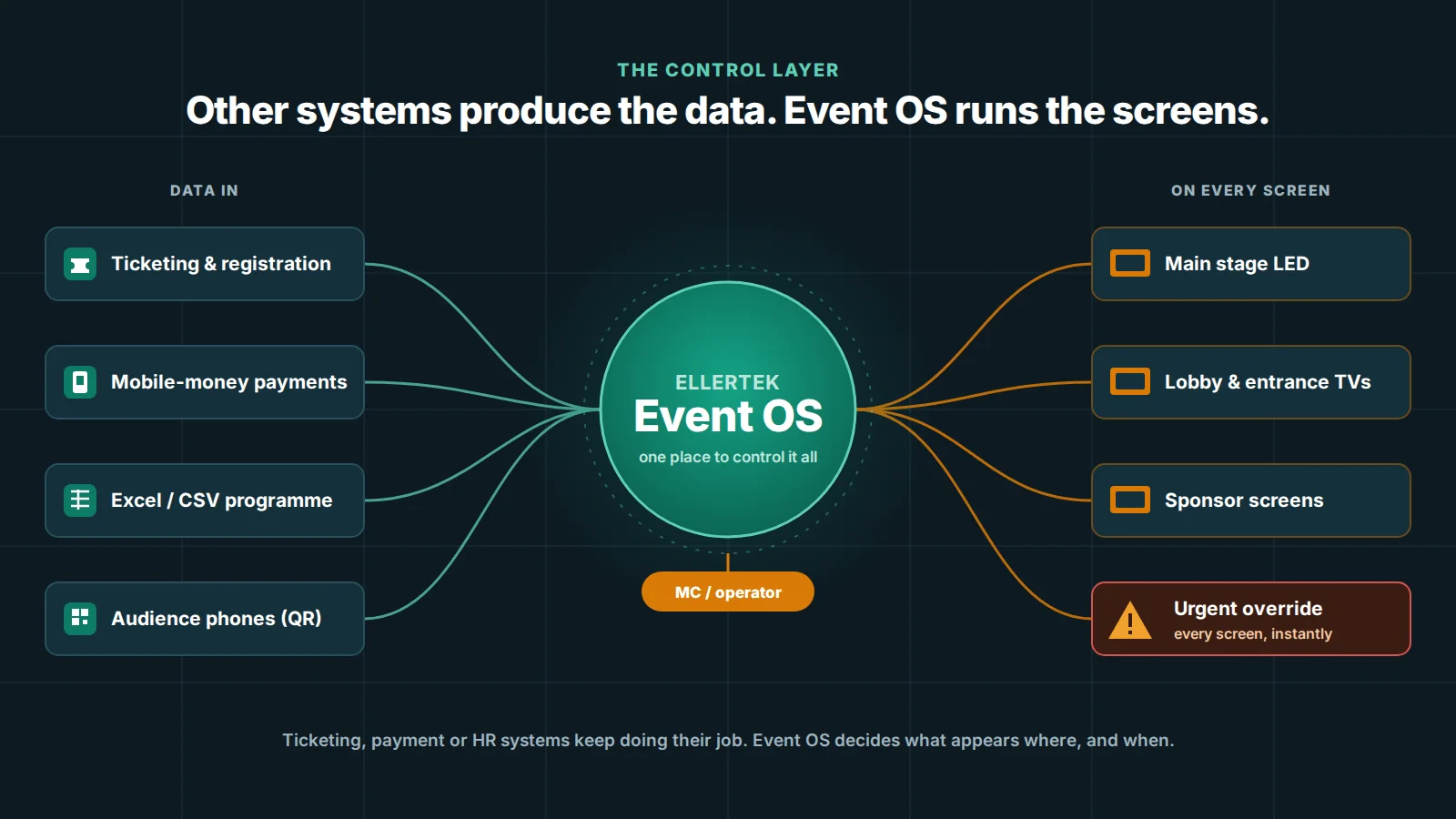
EventOS does not need to replace every system used by an organizer. Ticketing, payment, production, HR or factory-management systems may continue producing their own data.
The role of EventOS is to receive the required information and present it effectively on the appropriate screens.
Try Ellertek LIVE — Event OS
One PC, unlimited screens, zero internet. Free 3-day trial — every module unlocked.
Offline operation is important in East Africa
Many international event platforms assume that fast, stable internet will always be available. That assumption can create serious problems in Tanzania and neighbouring markets.
A temporary venue may have weak Wi-Fi. Mobile networks can become congested when hundreds of guests arrive. An outdoor event may have limited coverage. Even a good hotel connection can experience an unexpected interruption.
Critical event operations should therefore not stop simply because internet access has failed. (We covered this in more depth in why offline software wins in Tanzania.)
An East African event system should support local-network or offline operation for essential functions such as:
- Displaying the programme
- Updating announcements
- Running presentation timers
- Controlling venue screens
- Recording audience participation
- Validating previously downloaded attendance information
- Continuing draws or other scheduled activities
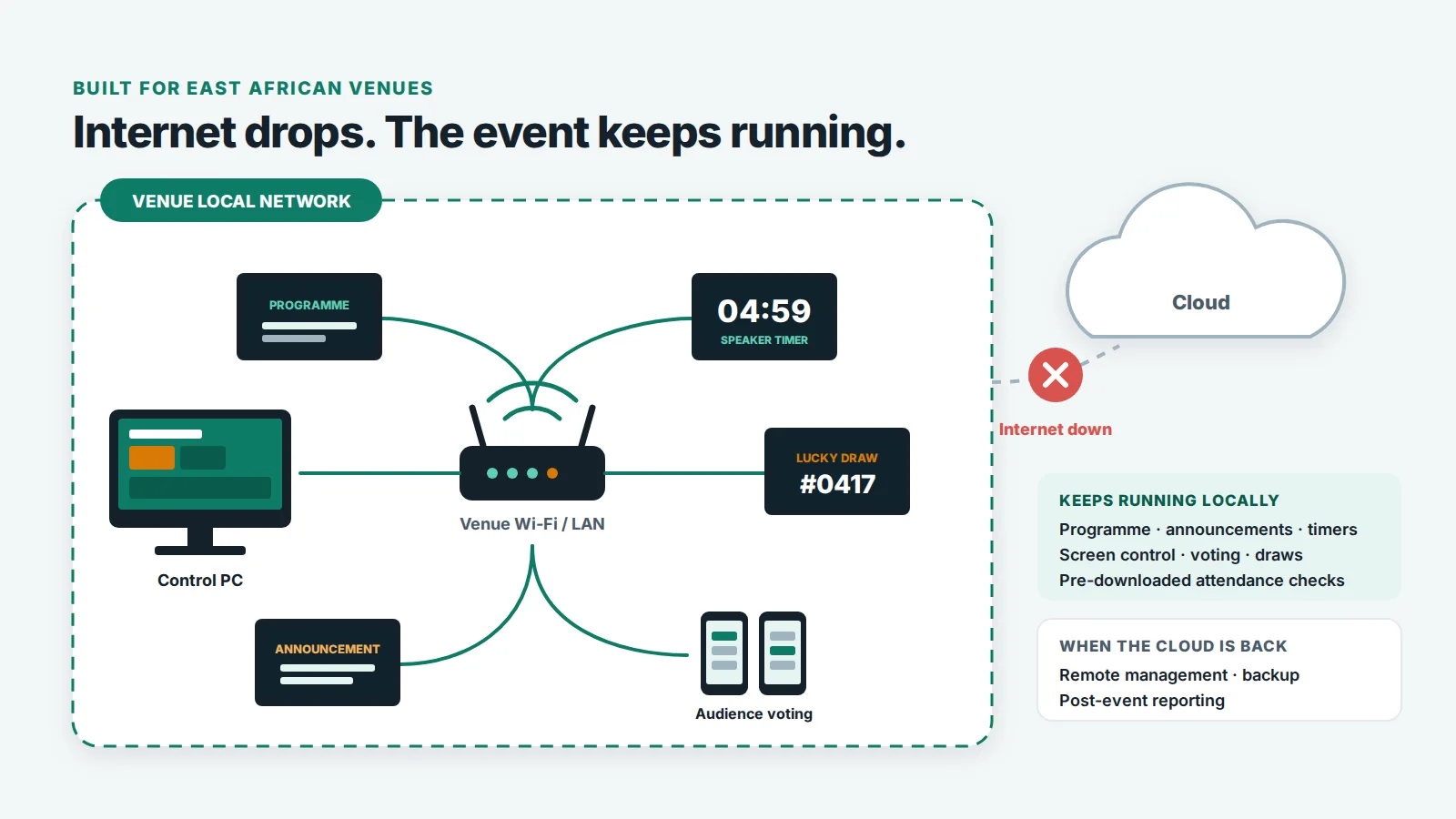
Cloud access remains useful for remote management, backup and reporting. But the live event should not become completely dependent on it.
Conference and venue investment is increasing
Regional governments and tourism organizations are treating meetings, conferences and exhibitions as an important source of revenue.
According to the Uganda Tourism Board, Uganda's national MICE strategy (2025–2030) aims to attract over US$250 million into the economy. In Rwanda, as KT Press reported in September 2026, the government has deliberately positioned Kigali as one of Africa's leading MICE destinations, with the Kigali Convention Centre at its centre. Nairobi, Dar es Salaam and Arusha also host regional business, technology and investment gatherings.
AFCON 2027 will also be jointly hosted by Tanzania, Kenya and Uganda under the Pamoja arrangement, as the Uganda Broadcasting Corporation confirmed in September 2026. Although it is a sporting competition, its technology needs will extend far beyond stadium scoreboards.
Hotels, fan zones, transport points, hospitality venues and sponsor activations may require:
- Event schedules
- Venue directions and digital wayfinding
- Transport information
- Safety and crowd instructions
- Sponsor content
- Multilingual announcements
- Coordinated updates across multiple screens
The immediate opportunity for local technology companies may not be a direct contract with CAF. It may come through hotels, AV companies, production firms, fan-zone operators and organizations delivering individual parts of the visitor experience.
Event technology must produce measurable value
Organizers should not invest in technology merely because it looks modern.
A useful system should help the buyer achieve at least one measurable result:
- Reduce entrance queues
- Reduce programme and communication errors
- Improve sponsor visibility
- Increase audience participation
- Reduce dependence on printed materials
- Improve coordination between the MC and technical team
- Generate useful attendance and engagement reports
- Allow the venue to reuse the system for future events
This is also why the event-technology market is shifting toward software subscriptions and support services. Screens can be purchased from many suppliers. The greater long-term value comes from controlling the screens, connecting information sources, maintaining templates and supporting the client during live operations.
A practical EventOS workflow
A professional conference could use EventOS (for example, the Conference Pack) in the following way:
- Before the event: The organizer imports the programme, speakers, sponsors and approved announcements.
- At the entrance: Guest information from the registration or ticketing platform is used to monitor arrivals.
- During the event: The MC or authorized operator selects what should appear on each screen. Session changes, countdowns and announcements can be updated immediately.
- For the audience: Guests participate through QR codes or mobile links without installing a complicated application.
- For sponsors: Approved advertisements rotate according to the agreed schedule.
- After the event: The organizer exports activity, attendance or engagement information for reporting and future planning.
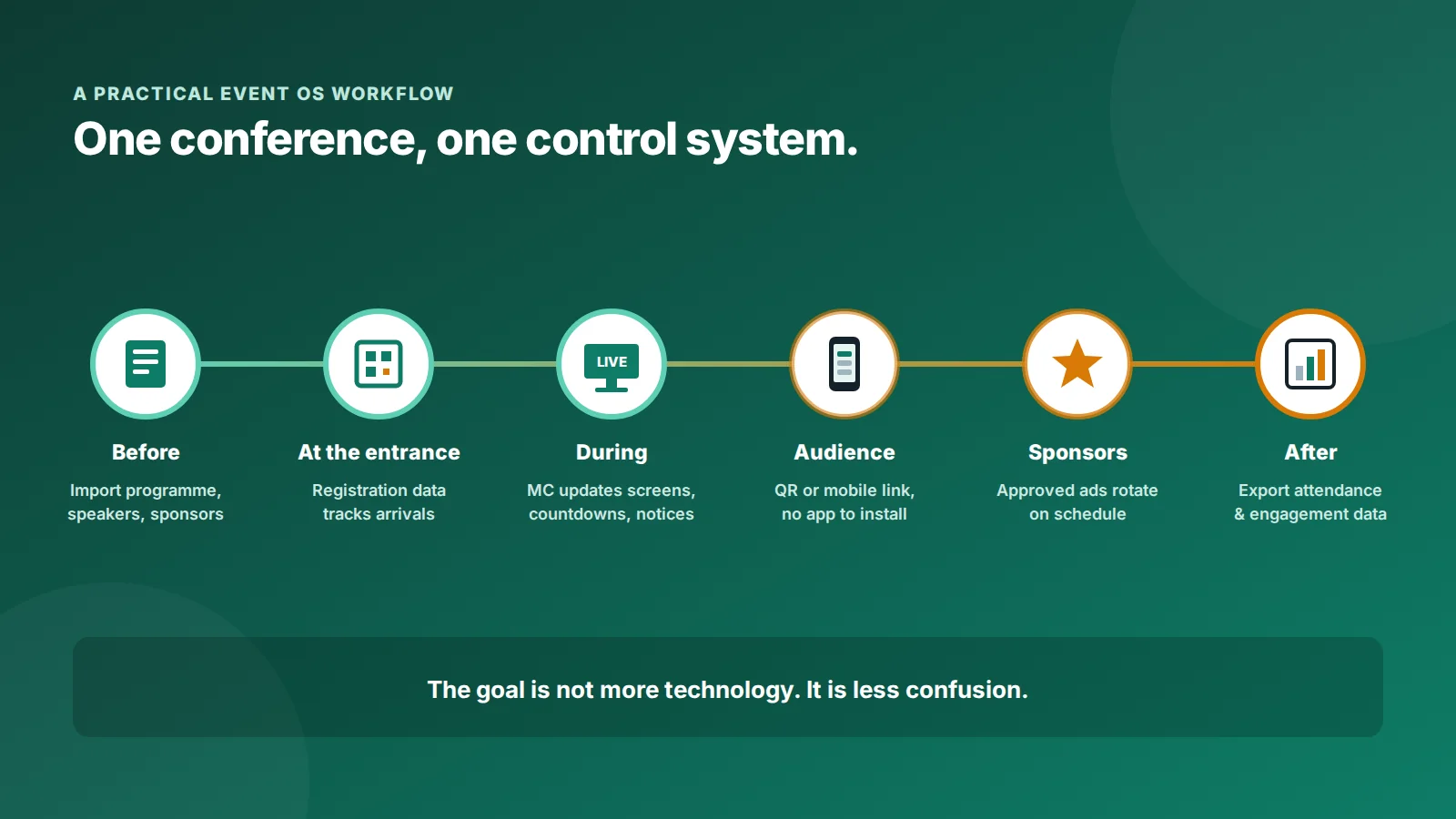
The objective is not to add more technology to the event. It is to reduce confusion by placing important live controls in one system.
What buyers should ask before choosing an event platform
Before purchasing event-management or display software, ask the supplier:
- Can the system continue operating when the internet fails?
- Can it use our existing televisions, LED screens or projectors?
- Can staff control several screens from one place?
- Can we import information from Excel, CSV or another system?
- Can different employees receive different permissions?
- Can urgent announcements override scheduled content?
- Does the system support local installation and training?
- What reports will we receive after the event?
- Is the price per event, per screen or per venue?
- Who provides support while the event is running?
The answers are more important than an impressive feature list. For a deeper buyer's guide, see our event management systems in Tanzania guide and our digital signage software comparison.
The opportunity for East African organizers
The next stage of event technology in East Africa will not be defined by screens alone. It will be defined by systems that make those screens useful, keep event teams coordinated and continue working under local conditions.
Ellertek EventOS is being developed around this reality: ticketing and other systems can produce the data, while EventOS controls how important information is presented inside the venue.
For organizers, MCs, conference venues, hotels, casinos and corporate event teams, the goal is simple: fewer manual errors, clearer communication and a more professional experience for every guest.
To request an EventOS demonstration or discuss a pilot installation, book a live demo, visit Ellertek LIVE or contact Ellertek Solutions.
Try Ellertek LIVE — Event OS
One PC, unlimited screens, zero internet. Free 3-day trial — every module unlocked.
Disclosure: IT Solutions Tanzania is operated by Ellertek Solutions Co. Ltd, the developer of Ellertek EventOS. Product references are clearly identified, while market developments are based on the publicly available sources listed below. All illustrations on this page were created by IT Solutions Tanzania.
Sources
- Live Nation Entertainment: Ticketmaster Enters East Africa as Quicket Launches in Uganda and Kenya (20 August 2026)
- AllAfrica: Ticketmaster-backed Quicket enters Kenya (August 2026)
- Karibisha: Event management and online ticketing platform
- JAVI Tickets: Event ticketing system in Kenya
- Uganda Tourism Board: Uganda to emerge as world's leading MICE destination with new convention centre
- KT Press: Why is the world choosing Kigali for MICE? (September 2026)
- Uganda Broadcasting Corporation: President Museveni assures CAF of Uganda's readiness to co-host AFCON 2027 (23 September 2026)